
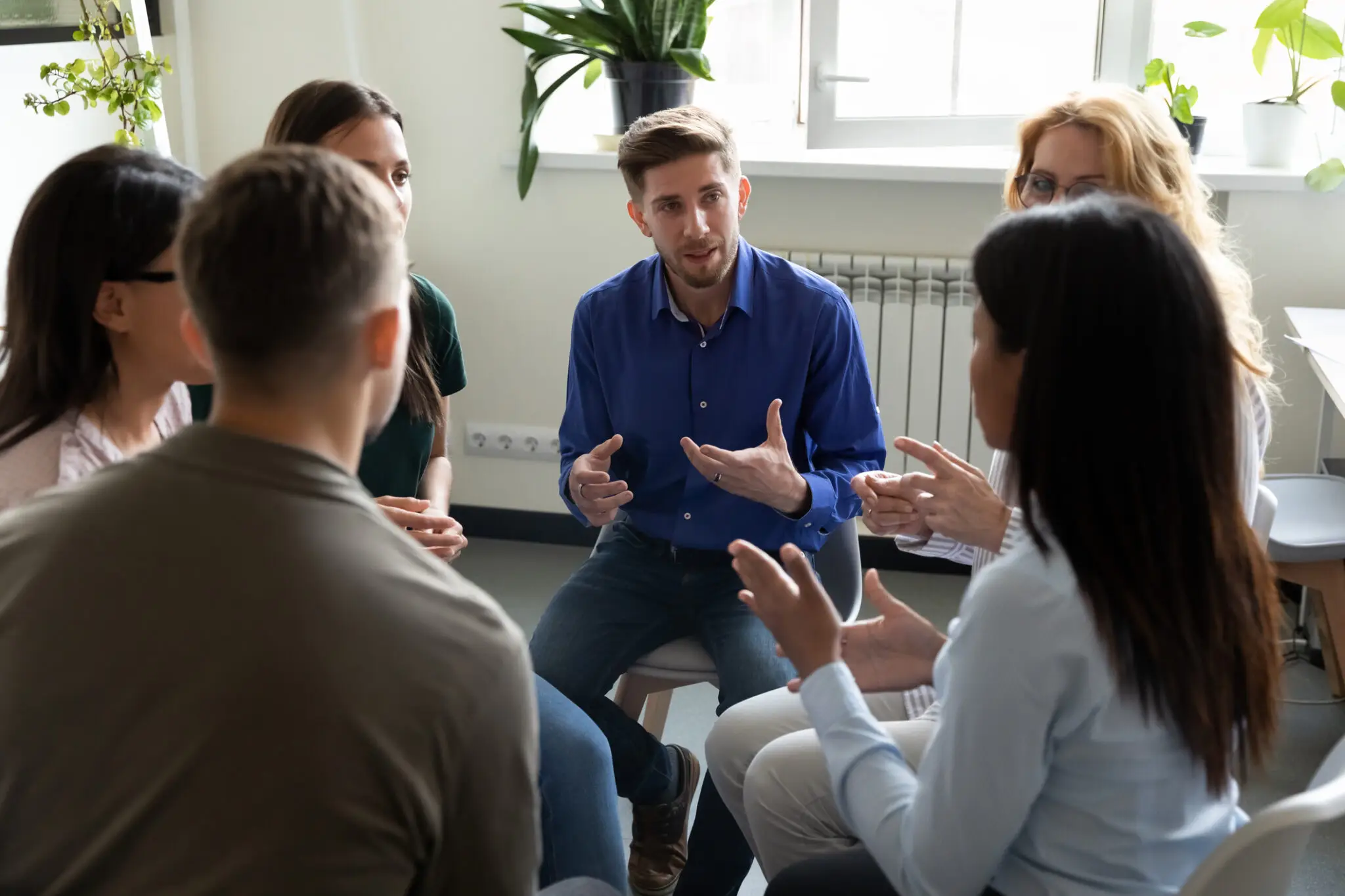
Most coaching happens one-to-one, a single coach and a single person. Group coaching changes the shape. One coach works with a whole cohort, and the learning spreads across the room.
What is group coaching?
Group coaching is a structured process where one trained coach works with a small group, usually six to twelve people, across a series of sessions. Members set their own goals, think aloud, and learn from each other’s experience. The coach guides the process and helps the group move forward together.
The coach does not lecture or hand out answers. The thinking comes from the group. One person brings a real challenge, the others ask questions and offer perspective, and the whole cohort sharpens its own practice in the process. Over weeks and months, a group builds trust, and the quality of the thinking rises with the trust.
Group coaching sits apart from training and from therapy. Training transfers knowledge from a teacher. Therapy works on the past. Group coaching works on live goals in the present, with the group as the engine.
How does group coaching work?
A group coaching programme runs on a simple rhythm. A small cohort meets on a regular cadence, and each session follows a shared structure the coach holds steady.
Cohort size matters. Six to twelve works well. Fewer than six loses the range of perspective. More than twelve leaves too little airtime for each person. Sessions run for ninety minutes to two hours, every two to four weeks, across three to nine months.
Most sessions follow a pattern. The group opens with a check-in. One or two members bring a live issue. The group explores the issue through questions rather than advice, and the coach keeps the questioning honest and the pace even. The session closes with each member naming a commitment, which the group revisits next time.
Two things hold the room together. A working agreement, set at the start, covers confidentiality, attendance, and how members challenge each other. And a coaching model gives the sessions a spine. Many coaches use the GROW or TGROW model, developed by Sir John Whitmore, to move a conversation from goal to action.
The coach’s stance shifts from the one-to-one norm. In a pair, the coach carries the whole conversation. In a group, the coach shares the work with the room, drawing quieter members in, holding the airtime even, and letting the group do the coaching while the process stays safe. Confidentiality does more heavy lifting than in one-to-one work, because trust across ten people is harder won and easier lost. Our guide to running a group coaching programme sets out the full session design.
Group coaching versus one-to-one coaching
Both formats change how people think and act. They differ in reach, cost, and the source of the insight. One-to-one gives depth and privacy. Group coaching adds peer learning and shared accountability, and reaches more people for the same coach time.
| Factor | Group coaching | One-to-one coaching |
|---|---|---|
| People per coach | Six to twelve | One |
| Cost per person | Lower | Higher |
| Source of insight | The coach and the peer group | The coach |
| Privacy | Shared within the group | Fully private |
| Peer accountability | Built in | Absent |
| Best for | Capability across a team, culture change, cohorts of leaders | Personal, sensitive, senior or bespoke goals |
Neither format wins outright. The choice depends on the goal. For a personal, sensitive, or senior-level issue, one-to-one fits. For building capability across a team, embedding a culture, or developing several leaders at once, group coaching does more for the budget. Our comparison of group coaching and one-to-one coaching works through the trade-offs in detail.
What are the benefits of group coaching?
Group coaching earns its place on evidence, not novelty. The gains come from the group itself, and four show up again and again.
- Peer learning. Members solve each other’s problems, and the act of coaching a peer sharpens their own practice. One issue in the room teaches the whole cohort.
- Shared accountability. A commitment made in front of a group carries more weight than a private note. Members return and report back, and follow-through rises.
- Psychological safety. A well-run group builds the trust to speak openly, take a risk, and admit a gap. Amy Edmondson’s research on psychological safety shows why teams learn faster when people feel safe to be candid.
- Reach and value. One coach develops a whole cohort at once, so more people gain access to coaching for the same investment.
The benefit compounds over a programme. As trust grows, members bring harder issues, and the group handles them with more skill. The evidence base sits alongside decades of action learning practice, where groups working real problems produce both a solution and a lasting change in how members think. Our deeper look at the benefits of group coaching sets out the outcome evidence and where the format delivers most.
Group coaching in healthcare and the workplace
Group coaching fits health and care work well. Teams carry heavy caseloads, decisions land fast, and reflection gets squeezed out. A group gives people a protected space to think, and turns individual pressure into shared learning.
In clinical and care teams, group coaching supports reflective practice, wellbeing, and the coaching skills staff use with patients. A ward sister, a physiotherapist, and a practice nurse in the same cohort each bring a different pressure to the room, and each leaves with a wider view of the work. In the wider workplace, cohorts of managers develop together, and a coaching habit spreads through the organisation rather than sitting with a few individuals.
The format also stretches a limited coaching budget. Health and care organisations rarely fund one-to-one coaching for every leader who would gain from a coach. A group programme reaches a whole layer of managers at once, so the investment lands across a team rather than a handful of senior people.
The format draws on a long tradition. Action learning, developed by Reg Revans in UK industry and later used across the NHS, brings a small group together to work on real problems and learn by doing. Group coaching carries this heritage into a structured programme. Our articles on group coaching in healthcare and group coaching in the workplace show the format in each setting.
How do you measure the impact of group coaching?
Measurement starts with the goal, not the survey. Name what the programme should change before the first session, then track the change through to the end.
Three layers work together. At the individual level, track the goals members set and the commitments they meet between sessions. At the group level, watch confidence, candour, and the depth of the issues the cohort brings over time. At the organisation level, tie the programme to a measure the sponsor cares about, from retention to engagement to a specific operational outcome.
Keep the evidence simple and honest. A short pre and post measure, a handful of member quotes, and one or two hard numbers the sponsor recognises will tell the story better than a long survey nobody reads. The point is to show whether the group changed how people work, and to learn what to adjust for the next cohort.
How do you run a group coaching programme?
Running a group coaching programme takes design before delivery. The strongest programmes plan the purpose, the people, and the process before the first session.
- Define the purpose. Name the outcome the programme serves, from leadership capability to wellbeing to a specific change goal.
- Choose the cohort. Six to twelve people with enough in common to relate and enough difference to stretch each other.
- Set the agreement. Agree confidentiality, attendance, and how members challenge and support each other.
- Plan the cadence. Fix session length, frequency, and the length of the programme up front.
- Pick a model. Use GROW, TGROW, or an action learning structure to give each session a clear shape.
- Facilitate well. Hold the space, spread the airtime, ask more than you tell, and keep the group safe and honest.
- Measure the change. Track goals, commitments met, and the outcomes the programme set out to move.
Two mistakes sink programmes early. The first is a cohort with nothing in common, where members struggle to relate to each other’s issues. The second is weak contracting with the sponsor, where the organisation expects a training course and gets a coaching programme instead. Agree the purpose with the sponsor before you agree the purpose with the group, so the outcome the organisation pays for and the work the group does point the same way.
Facilitation is the skill the whole programme rests on. A group coach manages several people at once, reads the room, and keeps the process honest without steering the answers. Our guides to group coaching facilitation skills and action learning and group coaching go deeper on the practice of holding a group.
How to train as a group coach
Group coaching asks for more than one-to-one skill. A group coach reads the room, manages several people at once, and holds a process running across months. Training and accreditation build this range.
Two bodies set the recognised standards for coaching in the UK and beyond, the International Coaching Federation and the European Mentoring and Coaching Council. Both accredit coaches and coach training, and both have raised the bar on group and team coaching skill. Supervision matters too. A group coach carries responsibility for several people at once, so regular supervision keeps the practice safe and sharp.
If you plan to train, look for a programme grounded in real practice, backed by accreditation, and supported by supervision. Our guide to group coaching training and qualifications and our overview of health coach certification and training map the routes.
Common questions about group coaching
What is group coaching?
Group coaching is a structured process where one trained coach works with a small group of people who each set their own goals. Members think aloud, learn from each other, and hold each other to account. The coach guides the process rather than teaching content.
How many people should be in a group coaching cohort?
Six to twelve people works best for group coaching. Fewer than six narrows the range of perspective, and more than twelve leaves too little airtime for each member. The right number depends on session length and the depth of the work.
What is the difference between group coaching and team coaching?
Group coaching brings together individuals who each pursue their own goals, while team coaching works with an intact team on shared goals. In group coaching the members often do not work together day to day. In team coaching they do, and the team’s collective performance sits at the centre.
How long does a group coaching programme last?
Most group coaching programmes run for three to nine months. Sessions of ninety minutes to two hours meet every two to four weeks. The length depends on the goal, and deeper change needs more time and more sessions.
Is group coaching as effective as one-to-one coaching?
Group coaching and one-to-one coaching serve different needs, so one does not replace the other. One to one gives depth and privacy for personal or sensitive goals. Group coaching adds peer learning and shared accountability, and develops more people for the same coach time.
What qualifications do you need to run group coaching?
No single licence is required to run group coaching in the UK, but recognised accreditation and supervision set the professional standard. Bodies such as the ICF and EMCC accredit coaches and coach training. A group coach also needs strong facilitation skills and regular supervision.
How does action learning relate to group coaching?
Action learning is a group method where members work on real problems and learn by taking action between sessions. Reg Revans developed the approach in UK industry, and the NHS adopted the method widely. Group coaching draws on the same principle, a small group learning together through real work.
Group coaching is more than a way of reaching more people. Done well, it creates the conditions for deeper thinking, shared accountability and lasting learning. For organisations looking to build capability, strengthen coaching cultures and make better use of coaching at scale, it offers a powerful and practical approach. If you want to bring group coaching to your team or train to run one yourself, talk to us about our group coaching programmes.